Pages

Showing posts with label Good Food. Show all posts

Thursday, April 29, 2010

Good Shepherd Garden Party Week 3: The Heavens Tell God's Glory!

Well, I'm a bit late posting last week's Good Shepherd's Garden Party but wanted to share nonetheless.

After spending time with the sheep in the pasture on week 1 and then feasting at the Lord's Table on week 2, we moved to the skies for week 3.


We are so blessed to have found this creative and meaningful way to celebrate the 50 days of Easter together as a family. This last week I realized that if I wanted to make this devotional time together more significant I needed to spend more time contemplating the stories and images from Scripture myself. Not only did it really change the way I presented the stories, this week's theme of God's creation declaring His Glory was just what I needed to hear myself. I mentioned that I had hoped to seek beauty during this Easter Season and at times I've been struggling to see the splendor in the ordinary, but through these passages of Scripture my eyes were opened afresh to the wonder all around me that I often turn a blind eye too. As Peter Mazar writes in the introduction to this week, "With our eyes to the skies we will open wide our senses to the wonders of nature, and we will praise the Lord who is the maker of all."


We had the opportunity to do just that on the Thursday night of this week--the day we learned about hail. For our special treat we headed out to Rita's Water Ice, as hail isn't quite rain or snow, water ice isn't quite water or ice! As we were loading up the car, we noticed the sun and blue skies (Sunday's theme) but then as we got out of the car again, the clouds (Monday's theme) rolled in. As we ordered, the rain started (Tuesday's theme), and their were flashes of lightening (Wednesday!). We decided to eat the rest of our water ice in the car on the ride home, when the wind (Friday's theme) really kicked up just as we turned onto a big boulevard lined with blossoming cherry trees. We pulled the car over as the wind whipped and swirled the blossoms around us in one of the most beautiful natural events I've ever seen. It was a true blizzard of pink blossoms. We were so amazed we could do nothing but laugh, even the baby just laughed and laughed. [When we read Friday's devotion the next day which asked, "Have you ever watched wind take blossoms from a tree and blow them into the air?" Everyone shouted, "Yes!!!"]

We love water ice!

By the time we were finished our water ice, the skies had cleared and were filled with a beautiful rainbow (Saturday's theme). All week my 5 year old daughter had been praying that she might see her first rainbow. The kids hopped and danced in glee. And I praised the Lord, maker of all, for the spectacular show. The Heavens declare the Glory of God, indeed!


We had our Garden Party on Saturday night with my parents as guests. Here are a few pictures of the food for our feast:

cupcakes to represent the sun, clouds and wind!

sugar cookies shaped like umbrellas and rain drops!

Rainbow Fruit Kababs. G made them all by herself!

Thanks to Shower of Roses and Waltzing Matilda for the recipes and ideas! For more posts, head over to Catholic Cuisine.


Monday, April 12, 2010

Garden of the Good Shepherd Week One


This year as part of our celebration of Easter as a season, we've been using the Garden of the Good Shepherd by Peter Mazar and illustrated by Tomie DePaola (I bought mine here for $6 or Waltzing Matilda also has free printables for those who didn't order the sticker book in time!). This large laminated scene with stickers serves as a calendar with a scripture passage and devotion for each day.

The first week's theme centers around the Jesus as the Good Shepherd, where we learn how Jesus promises to watch over us as a Shepherd does for his lambs and many other references to sheep in the Book of John.


Week Two we gather around the Table, reading Scriptures from the Old Testament of hospitality and feasting that evoke the Last Supper, the Emmaus Meal, the Eucharist, and our heavenly banquet. We continue throughout the 50 days of Easter to read Scripture of the sky, the sea, the garden and tree, the city and the animals. Each week helps us to see God's gifts all around us, the world "charged with the grandeur of God."

To help this fit with the celebratory tone of the Easter season, we are having a special treat and sometimes a craft or picture book to go along with the Scripture Reading. The kids have loved it and I'm so glad we have something to make this time memorable. The style of the devotions has been a refreshing change and have given me much food for thought during the week as the theme built.

This week as part of our Scripture memory and hymn study we worked on memorizing and singing Psalm 23, also with Keith Green's version and this new one.

We decorated our "altar" for the theme of the Good Shepherd with the children's Good Shepherd icon, a gift at their baptism last year, and lamb figurines we've picked up over the years at Easter.


On Easter Monday, we had breadsticks shaped as crooks and dipped in cinnamon sugar for breakfast! On Easter Tuesday, we ate popcorn to represent sheep and watched a movie on the Story of Jesus. On Easter Wednesday, we made these little treats to represent the gate of the sheepfold:


On Easter Thursday, we ate these lamb chocolates and made ewes and rams with cotton balls.


On Easter Friday, we had so much fun with Miss G's special friend making these sweet lamb cupcakes. The girls both 5 were able to decorate all by themselves!


On Easter Saturday, we had wolf paws to go along with John 10:11-12! Little Man dipped them in the chocolate and I made the claws with white icing. The favorite of the week to be sure!


 All of my ideas have come straight from Waltzing Matilda and Shower of Roses, so I claim no creativity in this project and when you see their pictures, not much skill either! Both of these lovely ladies have now set-up a party for each week with food themed for all of the lessons which seems like a great idea for those who would like to use the devotional each day but only do the crafts and food once a week. I think this is where we'll be by the last few weeks of Easter Season but for now the daily is working for us!

They are also hosting a link-up at Catholic Cuisine for more ideas; go check it out!

Thursday, March 18, 2010

St. Patrick's Day: The happy day when troubles we had not!

We had a fun day dedicated to St. Patrick and the Irish!

With the delicious colcannon and other Irish-inspired treats, we join the Irish in singing:

"Oh, wasn't it the happy days when troubles we had not,


and our mothers made Colcannon in the little skillet pot?"

It was hard to tell if RJ or the baby loved it best--they both gobbled it up!


The Clover Hunt:
 
Lunch was Shamrock sandwiches and green veggies:


Storytime with Dad:


We made Shamrock Junior Mint Cupcakes 
(Inspired from here and here.)


(We started the green beverages early.)

Miss G placing Junior Mints in the center of the unbaked cupcakes:


Mr. M sorting the green m&ms and gumdrops:


The Colcannon, we join in singing its praises:


Did you ever eat Colcannon, made from


lovely pickled cream? With the greens and scallions mingled like a


picture in a dream. Did you ever make a hole on top to


hold the melting flake of the creamy, flavoured butter that your


mother used to make?


Yes you did, so you did, so did he and so did I.


And the more I think about it sure the nearer I'm to cry.


Oh, wasn't it the happy days when troubles we had not,


and our mothers made Colcannon in the little skillet pot.


Monday, February 22, 2010

Pretzels for Lent

I've written about how we try to make small changes around our home during Lent to reflect the season and to remind us to pray, so I thought today I'd share how food can do this too.

"Lent is a period of fasting, self-denial and prayer, in imitation of our Lord's fasting, forty days and forty nights, and in preparation for the feast of Easter...
A traditional means of reminding the family that it is the holy season of Lent is the Lenten foods which are served only this time of the year. Thus parents and children realize, even at their meals, that prayer and penance should be practiced during these days.
The pretzel has a deep spiritual meaning for Lent. In fact, it was the ancient Christian Lenten bread as far back as the fourth century. In the old Roman Empire, the faithful kept a very strict fast all through Lent: no milk, no butter, no cheese, no eggs, no cream and no meat. They made small breads of water, flour and salt, to remind themselves that Lent was a time of prayer. They shaped these breads in the form of crossed arms for in those days they crossed their arms over the breast while praying. Therefore they called the breads "little arms" (bracellae). From this Latin word, the Germanic people later coined the term "pretzel."
Thus the pretzel is the most appropriate food symbol in Lent. It still shows the form of arms crossed in prayer, reminding us that Lent is a time of prayer." (from Catholic Culture)

I have tried a few different recipes and have found this one to be the easiest to work with and the tastiest.

Here is my step-by-step tutorial based on the recipe by Jeannie Yee at all-recipes.

1. Gather ingredients.

  • 1 (.25 ounce) package active dry yeast
  • 2 tablespoons brown sugar
  • 1 1/8 teaspoons salt
  • 1 1/2 cups warm water (110 degrees F/45 degrees C)
  • 3 cups all-purpose flour
  • 1 cup bread flour
  • 2 cups warm water (110 degrees F/45 degrees C)


2. In a large mixing bowl, dissolve the yeast, brown sugar and salt in 1 1/2 cups warm water. Stir in flour (this time I used 4 cups of all-purpose flour and they still turned out great).


3. Knead dough on a floured surface until smooth and elastic, about 8 minutes. In stand mixer, this took about 2 minutes on setting 2.


4. Place in a greased bowl, and turn to coat the surface. Cover, and let rise for one hour. 


5. After dough has risen, cut into 12 pieces. 


6. Roll each piece into a 3 foot rope, pencil thin or thinner. After the initial roll, let the dough sit a moment, it is then easier to work with and will roll and stretch more smoothly.


7. Shape into pretzels, or little arms crossed in prayer.


8. Place on greased cookie sheet or a parchment-lined sheet and let rise for another 15-20 minutes.


9. Bake at Bake at 450 degrees F (230 degrees C) for 8 to 10 minutes, or until golden brown. I took mine out a bit too early this time.

10. Then prepare dipping sauces. Melt 2 Tbsp of butter on one plate and then make plates for other favorite toppings-- salt, cinnamon sugar,etc.


11. Dip cooked pretzel in butter and then topping.


Delicious! Now if this is to be used for the traditional fast, the dipping in butter and toppings should be, of course, omitted. But we use the pretzels more to talk about the history of the church's fasting and use the pretzels as a call to prayer. This blog give more instructions on how to do this.

 
One note, if you like a really crusty outer layer on your pretzel, all-recipes includes a step of dipping pretzels in baking soda/water mixture before baking. This works well, but we've found it unnecessary.

Let me know if you try it out!!! 

Sunday, February 21, 2010

The Lord's Day is for Delight

Let us not forget, even in this season of Lent, our hope is sure. On the Lord's Day we remember what Christ's death and resurrection accomplished for us and we rejoice.


“For behold, I create new heavens
and a new earth,
and the former things shall not be remembered
or come into mind.
But be glad and rejoice forever
in that which I create;
for behold, I create Jerusalem to be a joy,
and her people to be a gladness.
I will rejoice in Jerusalem
and delight in my people;
no more shall be heard in it the sound of weeping
and the cry of distress. Isaiah 65: 17-19.


We enter into the Lord's delight of his redeemed creation.


A Sabbath walk, enjoying sunshine and melting snow.


We learn to receive with open hand the sun and the snow.


The Fast is broken with this gooey goodness.


These all look to you,
to give them their food in due season.
When you give it to them, they gather it up;
when you open your hand, they are filled with good things...
When you send forth your Spirit, they are created,
and you renew the face of the ground. Psalm 104:27-30.


We celebrate with joy the gifts from His Hands. 
 

 A Blessed Sabbath!

Amy


Thursday, June 25, 2009

Preserving the Harvest: Freezing Veggies


So we have a ton of vegetables ready to eat in our garden. It's a combination of ideal conditions, lots of travel, and hubby being gone. So I decided to try my hand at freezing the extras.

After doing a bit of research online and in my food preservation books, I decided the easiest, tastiest, and healthiest method would be to prepare and wash the vegetables, blanch them for 1-3 minutes, immerse in an ice bath, dry and place in freezer bags.

So now we have a freezer of Kale, Swiss Chard, Spinach, Bush Green Beans, Peas, and Sugar Snap Peas! It seems that none of these vegetables will be able to stand alone as a side dish but mixed into soup, rice, pasta, or a casserole, they'll be great. And hopefully I'll like having lots of organic vegetables, basically prepared in the fall!

I checked Preserving Summer's Bounty out from our library and it has been so helpful! I decided to commit one morning to freezing our veggies and it only took about an hour. But an hour of work for local, cheap, organic vegetables in the winter will be worth it. It has me questioning if starting next summer we could live the 100-foot diet in our urban backyard!

I appreciated this tip from Preserving Summer's Bounty that saved time and hassle: when attempting to quickly cool blanched vegetables do not immerse them in an ice bath where they will lose more nutrients into the water when drained and you will need new ice for each water bath. Instead, just place the blanched vegetables into a small container and then settle them on top of a larger bowl of ice and then place a bag of ice on top. This worked very quickly and saved the step of draining the vegetables again once they were cooled. You can then pop the ice bag into the freezer to use again!!

This post is part of the Food Roots series at Nourishing Days. Go check out more entries on local, seasonal foods or what people are doing to find your food’s roots. Thanks for visiting!

Food, Inc

Are you going to go see it? Starts tomorrow in our area!


Wednesday, June 17, 2009

Freezer Jam Video Demonstration

For those of you who don't believe making strawberry freezer jam is easy, check out this demonstration video from Ball. Sometimes seeing is believing!

Strawberries, sugar, fruit pectin and a freezable container is all you need.

Saturday, June 13, 2009

What's in season: Rhubarb


For my husband, eating rhubarb brings back fond memories of childhood. Since it is in season right now (ie. plentiful and cheap), I've picked it up at the farmer's market the last 3 weeks.


Rhubarb just looks like it should be nutritious and it is: Low in Saturated Fat, Cholesterol and Sodium and High in Dietary Fiber, Vitamin C, Vitamin K, Calcium, Potassium, Manganese and Magnesium. One serving of rhubarb has 35% of your calcium.


If your interested in reading more about this tart vegetable, check out Mother Earth News and this article on its history.
"Ben Franklin is credited for bringing rhubarb seeds to the North American east
coast in 1772, yet the red stalks did not catch on until the early 1800s, when
it became a popular ingredient for pie...The term rhubarb has also come to mean
a "quarrel" or "heated discussion." This comes from theatrical direction,
believe it or not. Stage and movie directors would have actors repeat "rhubarb"
and various other phrases over and over to simulate background conversations or
mutterings of a surly crowd."
Look for stalks 12-18" long, thin, crisp (think celery). It should be dark pink to red (generally the redder, the sweeter). One pound of rhubarb equals about 3 cups diced. It's perishable so use it within 3 days or cut it up and freeze.

If your not so sure you're family will like this tart relative of the celery plant for dessert, here is an easy-peasy recipe that is sure to please. I've made this 3 times now and everyone even two picky two-year olds gobbled it up!


Strawberry-Rhubarb Crunch

INGREDIENTS
1 cup white sugar
3 tablespoons all-purpose flour
3 cups sliced fresh strawberries
3 cups diced rhubarb (I cut it pretty small so the pieces are soft and blend more with the strawberries. For those of you who like the tart you may want to cut them into larger chunks.)
1 1/2 cups all-purpose flour
1 cup packed brown sugar
1 cup butter
1 cup rolled oats

DIRECTIONS
Preheat oven to 375 degrees F (190 degrees C).
In a large bowl, mix white sugar, 3 tablespoons flour, strawberries, and rhubarb. Place the mixture in a 9x13 inch baking dish.
Mix 1 1/2 cups flour, brown sugar, butter, and oats until crumbly. You may want to use a pastry blender for this. Crumble on top of the rhubarb and strawberry mixture.
Bake 45 minutes in the preheated oven, or until crisp and lightly browned.


(Here's a pretty strawberry-rhubarb dessert from Cooking Light with a bit less fat, but I haven't had the chance to try it yet!)


Thursday, June 11, 2009

Strawberry Lemondade Concentrate


Well, I am a real beginner at canning so it was my first attempt at Strawberry Lemonade Concentrate. I had to shop around for the lemons since our normal grocery store was charging $.79 a lemon--ahhh! It was delicious and easy to make. I pureed the strawberries, measured the sugar and made the lemon juice the night before when the kids were in bed so I only had to do the canning today.

With the time and money (and sugar!) that went into making it, I'll be saving the lemonade as a treat for our Saturday night Sabbath Feasts.I had been looking for a unique drink for the kids, just a little thing to help them look forward to our family time. Mom and Dad always have a glass of wine!


Here is the recipe for Strawberry Lemonade Concentrate

Makes about 7 pint jars

6 cups hulled strawberries
4 cups freshly squeezed lemon juice (about 20 lemons; they vary in their juicyness)
6 cups granulated sugar

1. Prepare canner, jar, and lids.
2. In a blender or food processor, puree strawberries until smooth. Transfer to a large stainless steel saucepan as completed. Add lemon juice and sugar and stir to combine. Heat to 190degrees over medium-high heat, stirring occasionally. Do not boil. Remove from heat and skim off foam.
3. Ladle hot concentrate into hot jars, leaving 1/4" head space. Wipe rim. Center lid on jar. screw band down until resistance is met, then increase to fingertip-tight.
4. Place jars in canner, ensuring they are completely covered with water. Bring to a boil and process for 15 minutes. Remove canner lid. Wait 5 minutes, then remove jars, cool and store.

To reconstitute, mix one part concentrate with one part water, tonic, or ginger ale; adjust concentrate to taste. (Since my kids don't drink much juice or sweet drinks, I made it almost two parts water to one part concentrate!)

Since I'm a newbie I'm afraid to play around with the recipe; I follow the instructions like their hocus-pocus so if you have any recommendations or tweak the recipe at all, let me know!


For those who are not into canning, here is a delicious homemade Lemonade recipe we love:

  • 1 3/4 cups white sugar
  • 8 cups water
  • 1 1/2 cups lemon juice
  1. In a small saucepan, combine sugar and 1 cup water. Bring to boil and stir to dissolve sugar. Allow to cool to room temperature, then cover and refrigerate until chilled.
  2. Remove seeds from lemon juice, but leave pulp. In pitcher, stir together chilled syrup, lemon juice and remaining 7 cups water.

Wednesday, June 10, 2009

a defense of home food preservation and how to start with a bunch of little ones underfoot!

This is the time of year for good eats. Vegetables and fruit are plentiful in the garden, at the farmer's market, and on sale at the grocery store. The time of year when many of our great-grandmothers and their mothers and their mothers (the first frugal, simple, green-living mommas--thanks, Allie!) began preserving the harvest.

But then we were persuaded that this sort of work was drudgery. We were convinced that what came from the grocery store was more convenient and more sophisticated...That faster was better...

But after reading books about eating a local, sustainable diet (Nabhan, Pollan, Kingsolver, Berry, Slow Food Movement) it's hard to not want to lock up as much of the summer goodness as you can. And it's hard not to question thin promises of convenience, efficiency, and freedom. I've had all kinds of work that I could label at times as drudgery--sales clerk, teaching, writing, grading, even when I was a travel director. I've waited in line at the fast food restaurant and no matter how fast it comes, do we really think it's worth it? We're beginning to hear more of the costs of this type of eating for our health and our environment.

And yet, for me, trying to preserve our food myself is a challenge. First, I don't know what I'm doing! Second, I've got 3 children under 5. Isn't it enough to spend my time caring for them? Why learn this new time-consuming task?

It's a way to be frugal by stocking up on fresh fruit and vegetables at their cheapest (though there is the initial cost of jars and other equipment).

It's a way to eat well--produce is at the peak of its freshness a
nd tastiness, packed with sunshine and vitamins. No additives, high-fructose corn syrup and other things we can't pronounce.

It's a way to become self-sufficient and productive. Most household economies produce nothing. We consume and consume and consume with little to show for it. We grow so tired consuming that we need to stop at the fast food store on the way home to cope; we complain of the drudgery.That's not the way it always was.
And women's lives were filled with the knowledge and effort of real work for the good of their household. Work which brings delight to a family when a jar of homemade strawberry syrup is cracked open on a wintery morning.

And for these reasons and more, it's a way to eat sacramentally. In chapter one of his book, Living the Sabbath, Norman Wirzba explains that sacramental eating affirms the grace and beneficence of God made concrete: "we can learn to grow food and eat in a way that reflects thanksgiving and praise to God" (p. 27). As an illustration, he describes his grandfather, a small-time chicken farmer, who ate with a "realistic and palpable sense of the goodness and the costliness of creation--after all these chickens had died so he could eat. Their death could not be taken lightly, nor could their living. And so [the chicken's] very being demanded [the family's] respect and care. His eating was a sacramental eating, because it affirmed the grace and beneficence of God made concrete in the midst of his living. It was a Sabbath eating, permeated by his thanksgiving and praise to God" (p. 28).

And so, in this light, my small attempts to seek out good, healthy, sustainable, (yet affordable) food and then to preserve it for our family's use becomes a way for me to move toward more grateful and worshipful ways of being.

But how do we begin? Though I suggested some of these possibilities in this post, I'd like to suggest that preserving food through canning, freezing and drying is another place for sacramental eating to start.

And so here are a few ways that I have begun my attempts at food preservation over the last few years even when pregnant or with a new baby or little ones underfoot.


1. Learn from those who know. While I am a book person and I turn to the Internet for the littlest questions, there is nothing better than getting to watch up close and ask questions from someone of experience. Back in Wisconsin, I showed no shame and asked the women in my church who I heard put up their own tomato sauce if I could come over on one of their canning days. I asked a pie baker and a pesto maker to give me lessons. I was surprised when they seemed flattered and graciously shared advice and techniques. I enjoyed their company and hope I even helped. Space was created for fellowship as our conversations floated to topics such as house management, schooling, discipline, and God's work in our lives. "Work Bees" aren't part of most communities anymore and we wonder why it is so difficult to naturally create the kind of nurturing that Titus 2 describes.

If you don't know of anyone, ask a like-minded friend who also wants to learn. My sister-in-law has been great for this as I posted about here. With a friend, someone can hold the fort down, while the other nurses the baby or changes a diaper; children are occupied with a friend to play with.

2. Start with a clean work station. Tidy your house the night before, clear off lots of space on your counter tops. Wash all your jars and lids ahead of time.


3. Check and prep as much as possible the night before. Reread the directions and ingredients list. In a busy household, nothing can set you back more than a sink of dirty dishes or missing 1 tablespoon of lemon juice!


4. Plan ahead for meals that day. This is your morning for cold cereal and a banana and an even easier lunch. Have dinner ready to go in the crockpot or use up meals in the freezer. Nothing is more frustrating that to have worked for hours in the kitchen to then realize its supper time and you have nothing to show for it.

5. Plan what you'll do with your little ones. Maybe you can swap babysitting with a girlfriend--what an incentive to preserve--a morning to yourself?! But otherwise, have coloring books, playdough, or a new book on tape ready to go. And though we try to limit all screen time in our house, we're all about letting them watch an online classic sesame street video or an old Disney opera from the 1930s here and there.

But best of all, try to incorporate them into your activities.

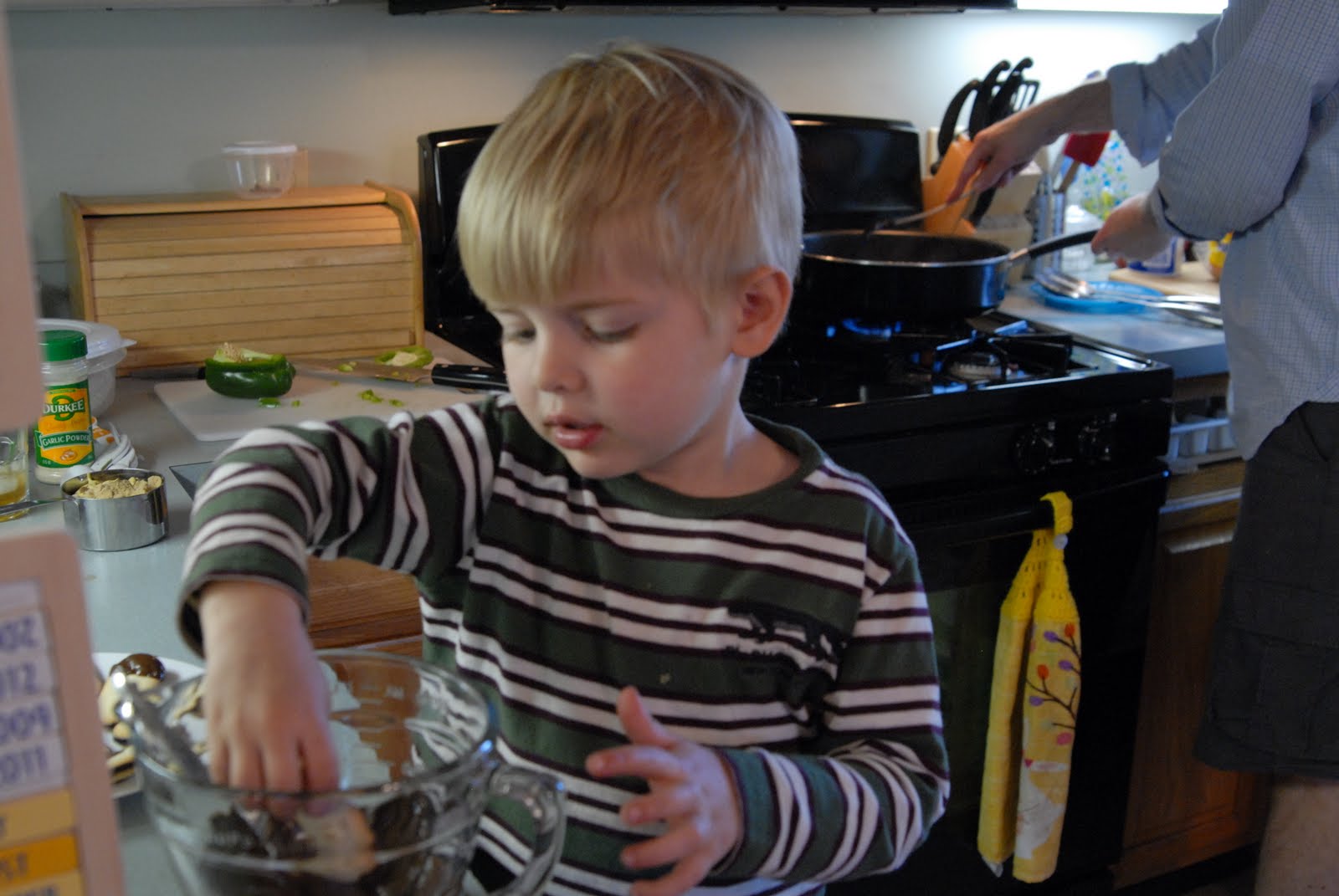
Even preschoolers can fill the measuring cup with berries, be in charge of the mashing, cut off stems. In doing so, they get time with you. They learn all sorts of skills-measuring, counting, volume, following directions, fine motor skills. You also start instilling a culture of work and good habits into their life which can turn into their own experiences of delight.


6. But since your household is a busy one, minimize as many distractions as possible. Like the telephone! Use a timer; I never used one before kids but now I can stick something in the broiler for 3 minutes and then head off to change a diaper and completely forget the oven. Canning has lots of directions like boil for 15 minutes or simmer for 3 so I use a timer.


7. Start with easy stuff. Try one new thing each week or month or year!
For those of you who have never canned before, freezing your fresh herbs and vegetables is a simple start. Freezer jam is another great way to cheat at canning for the first timer. It requires little effort and is so delicious. Then build your repertoire slowly. Conquer your favorite fruit, put up your prized tomatoes.

Well, like I said, I have much to learn in this area and for much of my life I would have been resistant to the idea, but my hope is that "as our sensitivities expand and as our appreciation for the complex, gracious ways of God grows, we will gradually find that gratitude and praise are irrepressible. To experience God's hesed or covenantal love in the midst of our practical living is to enter God's domain of blessing and joy...As we learn to attend and respond to the creative, vivifying action of God among us, we will learn to participate in a Sabbath singing that is now attuned to and extends God's rhythms of delight and peace" (Weirzba p. 29).

All that from a jar of tomato sauce? Sign me up!

LinkWithin

Related Posts with Thumbnails